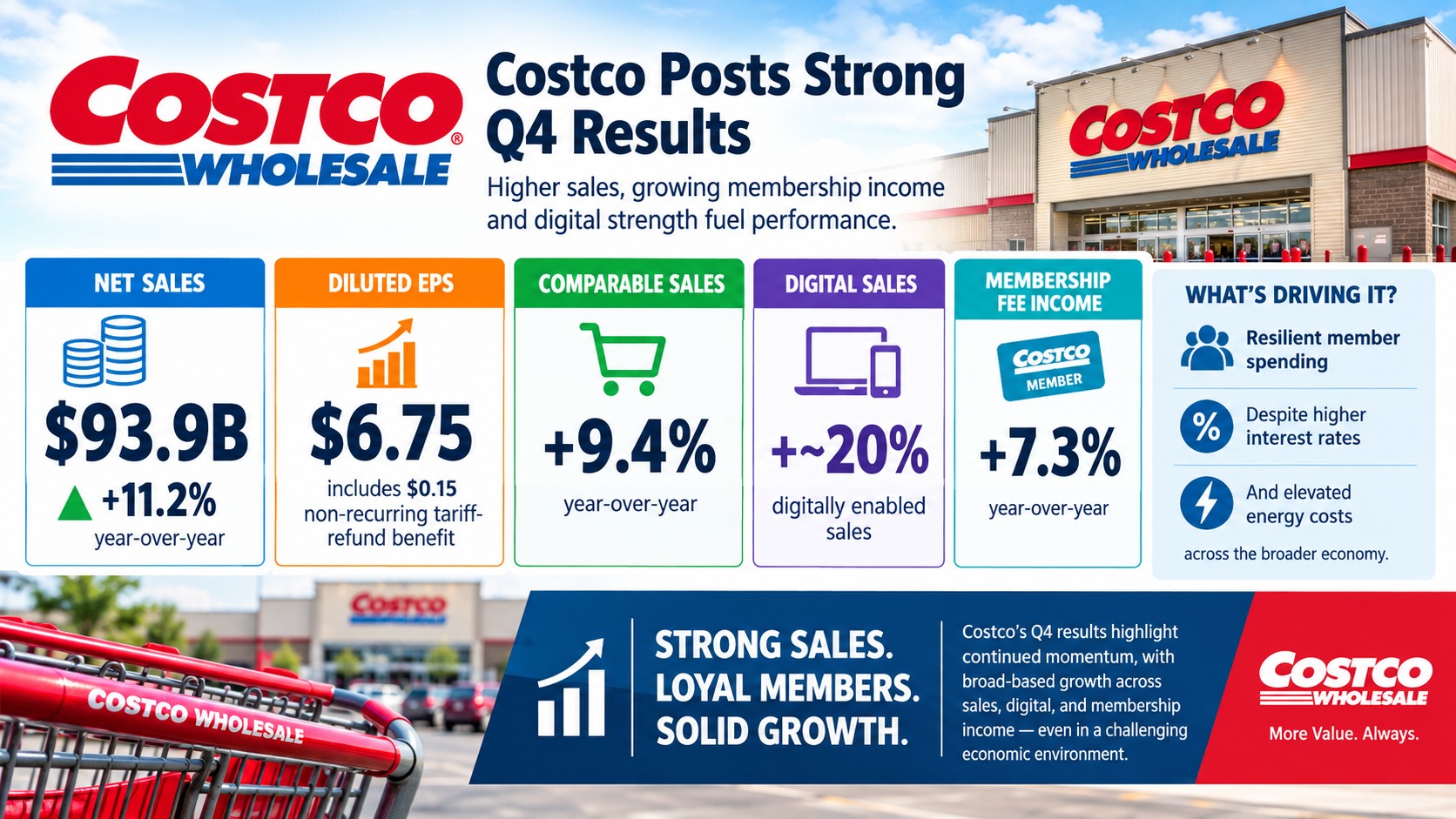
Costco Wholesale Corporation delivered a solid finish to fiscal 2026, posting fourth-quarter net sales of $93.9 billion, an 11.2 percent increase from $84.4 billion a year earlier. Diluted earnings per share reached $6.75 compared with $5.87 in the prior-year period. The EPS figure included a non-recurring $0.15 benefit from IEEPA tariff refunds, partially offset by reinvestment into lower member prices. Excluding that item, underlying EPS still advanced roughly 12 percent. Comparable sales rose 9.4 percent for the 16-week quarter; after adjusting for gasoline price inflation and foreign-exchange effects, the gain was 6.7 percent. Digitally enabled comparable sales climbed nearly 20 percent, continuing a multi-year trend of e-commerce acceleration.
Membership fee income advanced 7.3 percent to $1.85 billion, supported by a worldwide paid-member base of 84.1 million and a renewal rate of 89.8 percent. Executive membership penetration hit a new high. For the full 52-week fiscal year, net sales reached $297.2 billion, up 10.1 percent, while net income totaled $9.226 billion, or $20.76 per diluted share. The company opened 28 new warehouses during the year and plans 33 openings in fiscal 2027, with continued emphasis on both U.S. and international expansion. Management highlighted resilient spending across food, hardlines and discretionary categories, noting that members continue to respond to value even as mortgage rates and energy prices remain elevated.
Shares of Costco traded mixed in the wake of the report as investors weighed the clean operational beat against the one-time nature of the tariff benefit and the stock’s premium valuation. Analysts focused on the durability of membership growth and the company’s ability to convert tariff savings into sustained traffic rather than temporary margin lifts. The results reinforce Costco’s defensive positioning in a higher-rate, higher-oil environment, though the absolute valuation leaves limited room for disappointment in coming quarters. Chief Financial Officer Gary Millerchip told investors on the conference call that members continue to show willingness to spend in discretionary areas when they see exciting new items at great value.
The company also noted that the initial tariff refunds represent just more than a third of the total refunds Costco expects to receive in the current first quarter, with plans to continue reinvesting a majority of those savings into lower prices for members. Gross margin rate came in at 11.02 percent, down 11 basis points year-over-year, but excluding gasoline inflation the margin improved 20 basis points. Digitally enabled sales exceeded $33 billion for the year, up more than 20 percent, underscoring the ongoing shift in member shopping behavior. Membership base under age 40 has grown nearly 60 percent since the pandemic and now represents more than a quarter of total members, a demographic that tends to engage heavily with both warehouse and digital channels.
Looking forward, Costco’s ability to maintain high renewal rates and expand executive membership penetration will be critical to sustaining fee income growth. The planned acceleration in warehouse openings provides a clear volume lever, while the company’s scale continues to support competitive pricing even in an inflationary environment. Investors will monitor comparable-sales trends in the current quarter for any signs of consumer fatigue, particularly in discretionary categories. For now, the combination of membership strength, digital momentum and disciplined capital allocation keeps Costco among the most closely watched defensive names in retail as markets navigate elevated yields and geopolitical uncertainty.