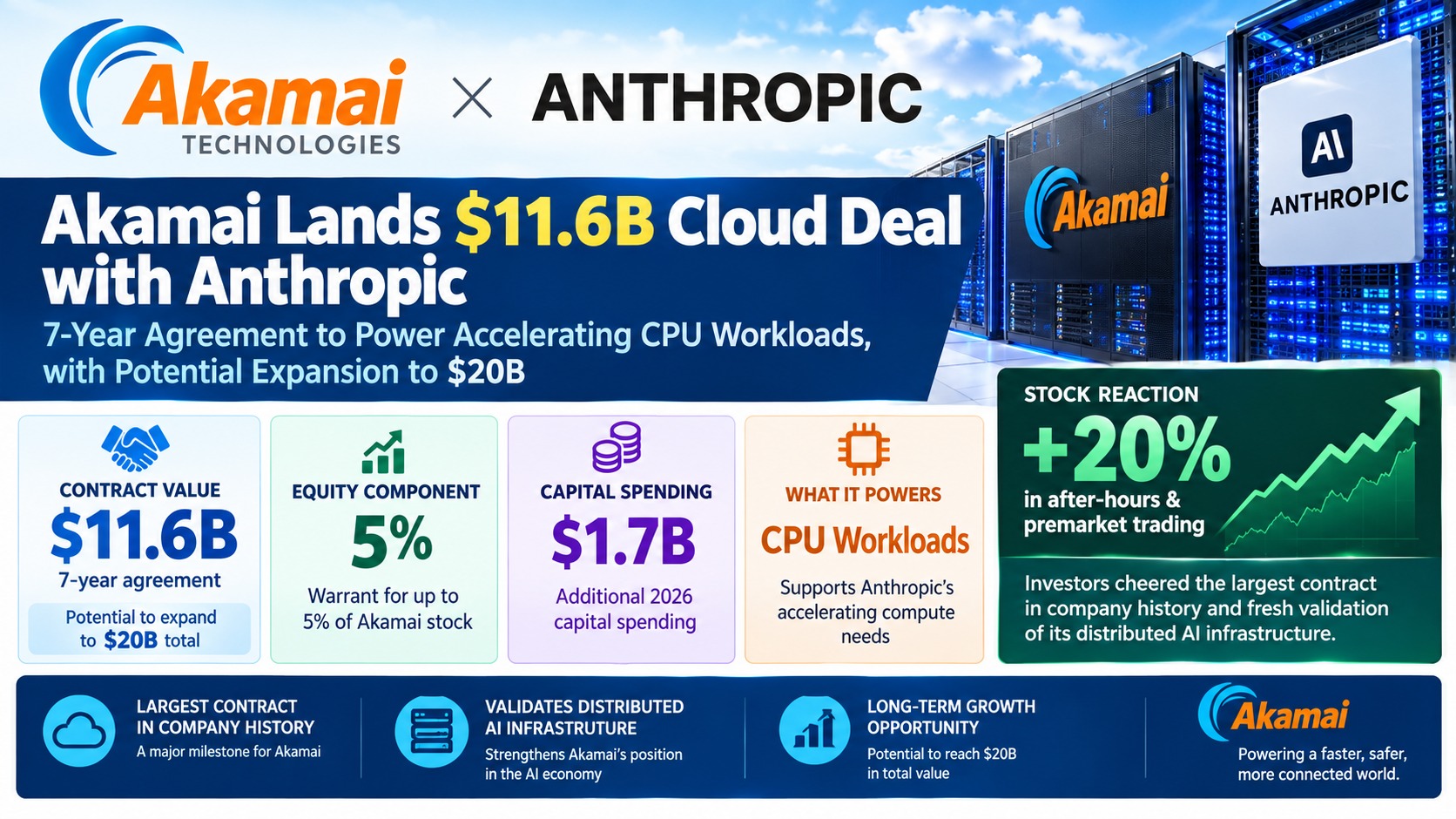
Akamai Technologies Inc. announced a landmark $11.6 billion, seven-year cloud computing agreement with Anthropic PBC that immediately reshaped investor views of the content-delivery and cybersecurity specialist. Under the contract, Akamai will supply distributed CPU capacity and software infrastructure to support Anthropic’s rapidly growing inference and general-purpose workloads. The agreement also contains an option for Anthropic to expand its commitment by as much as another $9 billion, lifting the potential total value to approximately $20 billion. As part of the strategic alignment, Akamai issued Anthropic a warrant covering non-voting convertible Series B preferred stock that can convert into roughly 7.7 million shares of common stock—about 5 percent of shares outstanding—at an exercise price of $111.33. Approximately 2 percent of the warrant vests with the initial commitment, while the remaining 3 percent vests as Anthropic increases its spend in $3 billion increments.
Akamai estimates total capital expenditures linked to the deal at $5.5 billion and raised its 2026 capex outlook by $1.7 billion to secure memory and other critical components. Management emphasized the transaction will not alter the company’s previously issued full-year revenue guidance. The announcement propelled Akamai shares more than 20 percent higher in extended trading and kept the stock among the strongest premarket gainers on Friday. Traders cited the deal as validation that Akamai’s edge-to-core architecture can compete effectively for large-scale AI infrastructure spend that has largely flowed to hyperscalers. Anthropic, already committed to multi-gigawatt deals with Amazon, Google, Microsoft and others, continues to diversify its compute supply chain amid soaring demand for Claude models.
Market reaction spilled into related names, with several semiconductor and infrastructure stocks firming in sympathy. Analysts noted the contract underscores a broader shift toward CPU-heavy inference workloads that favor geographically distributed platforms over pure GPU clusters. Akamai’s existing base of more than $2.8 billion in multi-year cloud infrastructure commitments announced earlier in 2026 now looks even more robust. The company said a portion of the new capital spending will be used to pre-purchase critical supply-chain components, including memory, under an existing services agreement with electronics firm Jabil. This proactive approach is intended to mitigate potential bottlenecks as AI demand continues to accelerate across the industry.
Investors will watch closely for any incremental guidance updates on the next earnings call and for signs that other AI labs follow Anthropic’s lead. In the near term, the deal injects fresh momentum into a stock that had lagged pure-play AI beneficiaries, while reinforcing the narrative that specialized cloud providers can still capture meaningful share of the generative-AI build-out. The transaction also highlights growing recognition that not every AI workload requires the highest-end GPUs; many inference and supporting tasks run efficiently on CPUs, a segment where Akamai’s global network of points of presence offers latency and cost advantages. Management described the partnership as a significant expansion of an existing relationship and positioned it as further evidence that demand for distributed AI infrastructure remains robust even as capital costs rise industry-wide.
Looking ahead, the market will focus on execution risk around the elevated capital plan and the pace at which Anthropic ramps usage. Successful delivery could open the door to additional large-scale agreements and support multiple expansion of Akamai’s valuation multiples. Conversely, any delays in component availability or slower-than-expected utilization would test investor patience. For now, the combination of a multi-year revenue visibility boost, an equity-linked warrant that aligns incentives, and a clear signal of AI-driven demand has shifted sentiment decisively in Akamai’s favor on a day when broader markets were already finding relief from easing oil prices and bond yields.