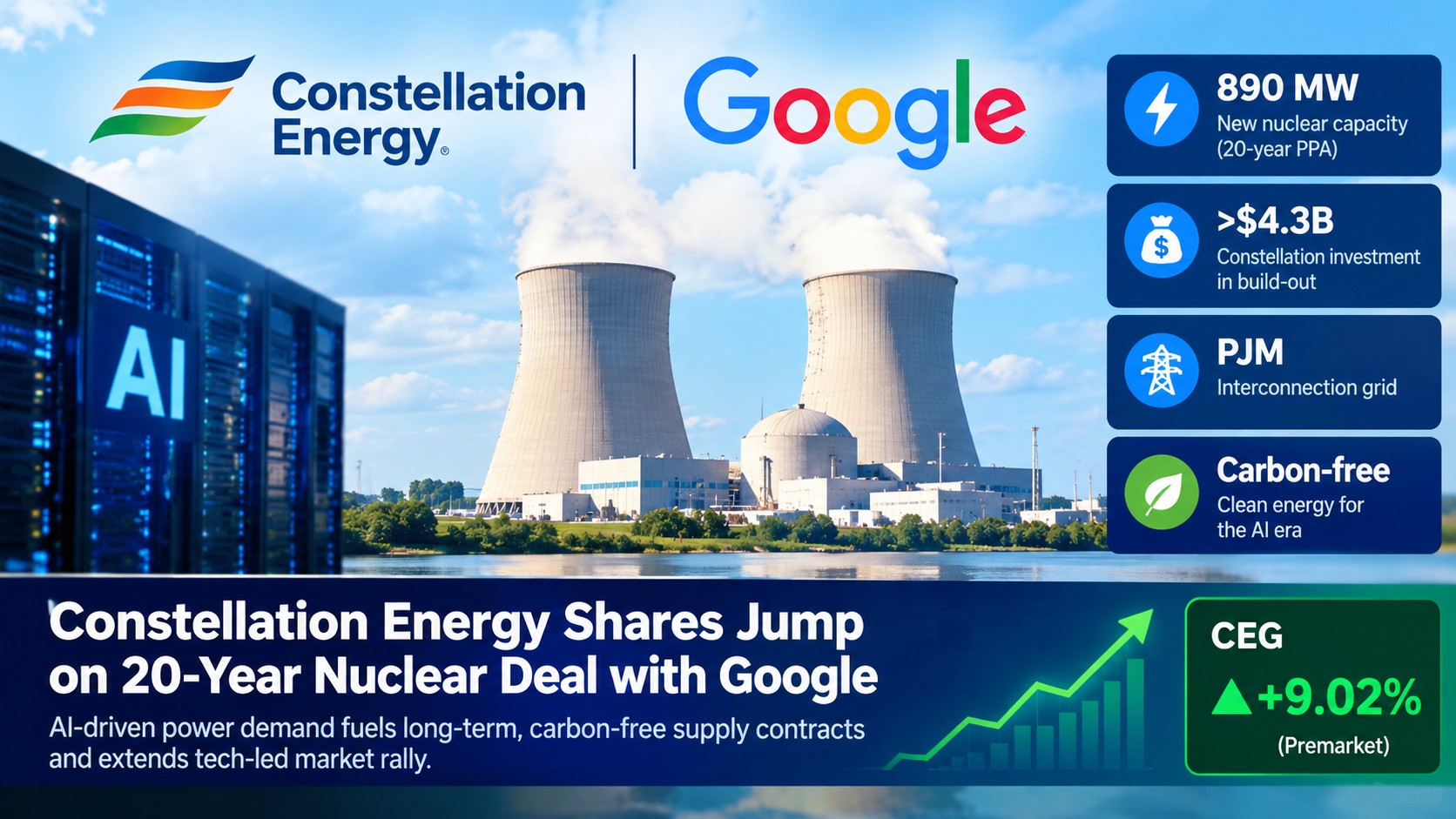
Constellation Energy shares jumped 9.02% in premarket trading on Tuesday after the largest U.S. nuclear power operator and Google announced a 20-year power purchase agreement to bring 890 megawatts of new nuclear capacity onto the PJM Interconnection grid.
Constellation will commit more than $4.3 billion to fund the build-out. Pairing a large capital outlay with a two-decade contracted buyer is meaningful for investors, because long-dated agreements give power producers revenue visibility and can reduce the risk of developing new generation at a time when project costs and timelines face intense scrutiny.
For Google, the agreement reflects a broader push among large technology companies to secure firm, carbon-free electricity for data centers. The AI buildout that has carried the Nasdaq to record highs depends on enormous and steady power supplies, and nuclear plants are attractive because they can run around the clock. The PJM grid serves a large swath of the eastern United States, including major data center corridors, which makes new capacity there strategically important.
The announcement landed as the tech-led rally continued. Analysts at Capital.com noted that the market is being driven not only by interest rate expectations and geopolitics but also by extraordinarily strong, if concentrated, earnings growth expectations tied to AI names. The Nasdaq closed at a record on Monday, and futures pointed higher again Tuesday as crude prices retreated after the G7 agreed to release 100 million barrels of oil reserves.
Investors will want more detail on timing, regulatory approvals, construction risk, and financing. The macro backdrop adds a wrinkle: the 10-year Treasury yield topped 5.3% on Monday, a level last seen in 2002, and the 30-year yield breached 5.7% at one point. Capital-intensive energy projects are sensitive to borrowing costs, so the durability of the rate backdrop matters as much as the contract itself.
The deal also highlights a theme that has been building across markets: companies that supply power, cooling, and infrastructure to the AI economy are increasingly treated as direct beneficiaries of hyperscaler spending. A contracted 20-year revenue stream from one of the world's largest technology companies is the kind of arrangement the market tends to reward with a higher valuation.
A 9% premarket gap also raises the risk of near-term profit-taking, particularly if broader sentiment shifts on oil, yields, or Iran-related headlines. Traders may prefer to wait for the opening range to establish before committing, while longer-term holders will focus on whether additional hyperscaler agreements follow and how quickly the new capacity can be brought online.