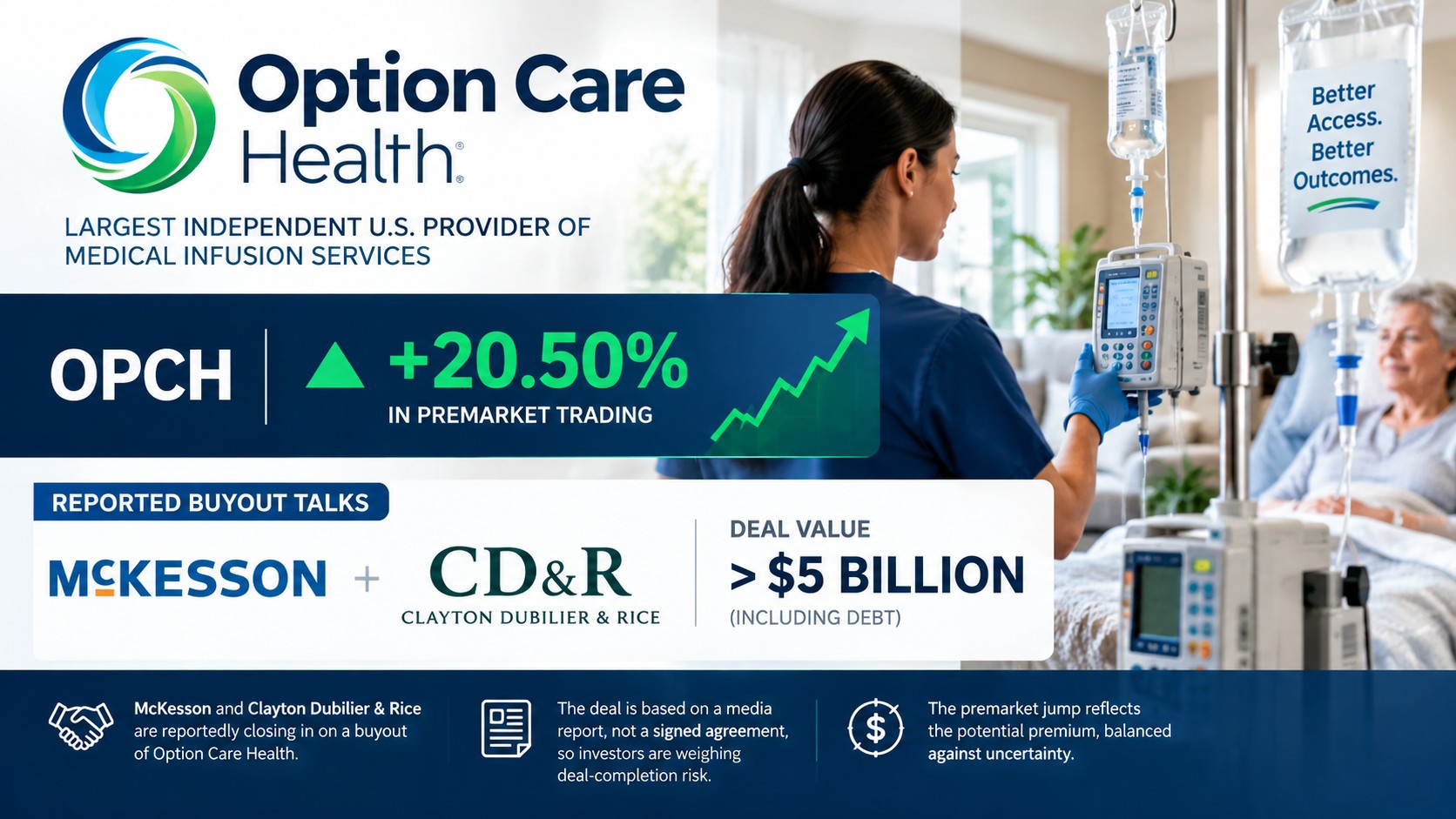
Option Care Health shares surged 20.50% in premarket trading on Tuesday after a report that McKesson and private equity firm Clayton Dubilier & Rice are closing in on a buyout of the company worth more than $5 billion, including debt.
Option Care Health is the largest independent U.S. provider of medical infusion services, delivering therapies administered through an IV or injection to patients outside traditional hospital settings. A take-private structure involving a financial sponsor alongside a large healthcare distributor would be an unusual pairing, and the details of how the two would share ownership or operations were not laid out in the coverage reviewed.
The jump of roughly one-fifth reflects how markets price takeover speculation. Investors typically bid shares toward the expected deal value before an agreement is signed while leaving a discount for the chance that talks stall. Because the report says the parties are closing in rather than having signed, the premarket move carries deal-completion risk, including the possibility of a lower price, delayed timing, or no transaction at all.
For the private equity firm, financing a deal of more than $5 billion including debt would come while the 10-year Treasury yield sits above 5.3%, a multidecade high that raises borrowing costs for leveraged buyouts. That backdrop could influence the final structure, the equity contribution required, and the price the sponsor is willing to pay. For McKesson, analysts will examine strategic fit and how a transaction of this size would affect its balance sheet.
The takeover headline arrived alongside a broader risk-on tone. The Nasdaq closed at a record Monday, futures were higher Tuesday, and oil prices were falling after the G7 pledged to release 100 million barrels of reserves. Other premarket movers included a nuclear power producer rallying on a technology-company power agreement and a medical technology company falling on a CEO succession announcement, illustrating how stock-specific catalysts are driving price action.
For paper-trading purposes, event-driven situations like this tend to offer limited upside once the headline gap is absorbed, since much of the expected premium is already reflected in the price. Buying after a 20% gap is effectively a bet on a signed agreement at or above the implied valuation. McKesson's shares, meanwhile, could see volatility tied to financing and strategic-fit questions as more details emerge.
Key items to watch include an official confirmation or denial from the companies, the price per share, the financing mix between equity and debt, and any regulatory commentary. Absent confirmation, the shares can reverse quickly. Infusion services also sit in a politically sensitive corner of healthcare, where reimbursement policy and site-of-care trends can shift economics, so diligence by any buyer is likely to be extensive.