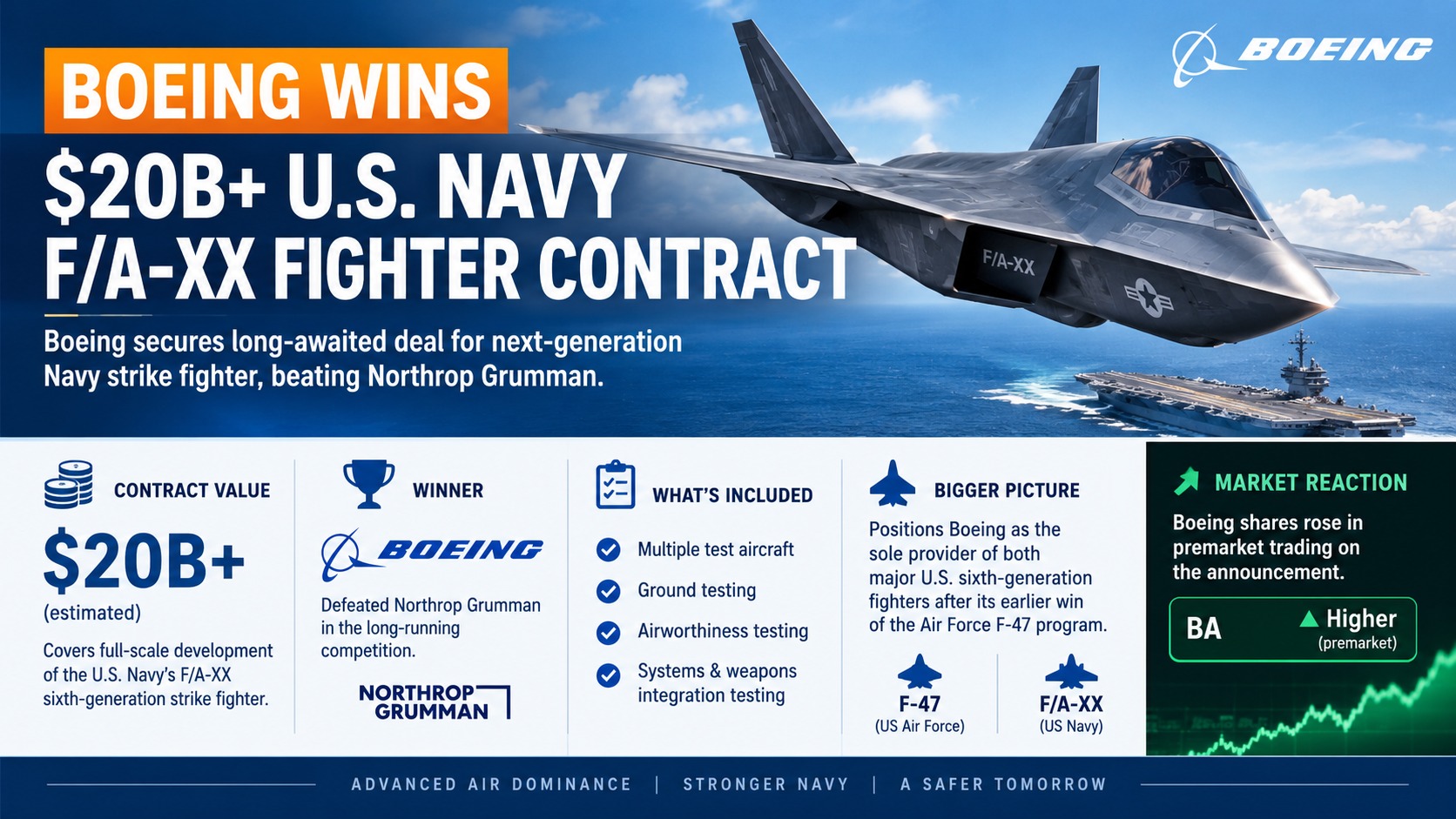
The U.S. Navy selected Boeing to develop and produce its next-generation F/A-XX carrier-based fighter under a contract valued at more than $20 billion for the full-scale development phase. The award includes multiple test aircraft intended for ground testing, airworthiness evaluations, systems integration, and weapons testing. The F/A-XX is designed to replace the aging F/A-18 Super Hornet and EA-18G Growler fleets beginning in the 2030s and represents a critical pillar of the Navy’s future air-power projection capabilities in contested environments.
Boeing prevailed over Northrop Grumman in the competition after an extended evaluation period that had seen the program pause for more than 18 months. The win follows Boeing’s selection in 2025 for the Air Force’s F-47 Next Generation Air Dominance program, giving the company both major U.S. sixth-generation fighter franchises. Steve Parker, president and chief executive officer of Boeing Defense, Space & Security, stated that delivering two advanced fighters in parallel had always been part of the company’s plan and that it had invested accordingly in facilities, technology, and workforce readiness to execute concurrent programs of this scale.
The F/A-XX is expected to incorporate advanced open mission systems architecture, next-generation sensors, greater operational reach and payload capacity, and sophisticated manned-unmanned teaming capabilities. Production will leverage Boeing’s expanded manufacturing facilities in St. Louis, including a large secure manufacturing complex that is among the most advanced aerospace production sites in the United States. The Pentagon described the aircraft as essential to maintaining peace through strength by dominating contested airspace and extending the operational reach of carrier air wings.
Shares of Boeing advanced following the announcement as investors digested the long-term revenue visibility created by the dual sixth-generation wins. The decision consolidates Boeing’s position in high-end military aviation at a time when the company continues to navigate challenges in its commercial airplane business. Analysts note that the programs could expand significantly beyond the initial development awards once production ramps and potential international customers express interest, though the primary focus remains on meeting U.S. Navy requirements for the 2030s and beyond.
Near-term attention will center on execution risk and capacity management across the two major platforms. Boeing has emphasized that its investments in digital design, manufacturing systems, and skilled labor position it to deliver both the F-47 and F/A-XX on schedule. The Navy contract also includes support for the eventual wind-down of Super Hornet and Growler production lines, providing additional clarity on the transition timeline. For the broader defense sector, the award underscores the prioritization of next-generation air dominance capabilities amid evolving strategic competition in the Indo-Pacific and other theaters.
The competitive outcome leaves Northrop Grumman without a prime role on either of the major sixth-generation fighter programs, a notable development given the company’s long history in advanced military aircraft. Market reaction focused primarily on Boeing’s strengthened franchise and the multi-decade revenue potential tied to both platforms. As details of the development schedule emerge in coming months, investors will monitor progress toward first flight targets and any adjustments to cost or timeline estimates that could affect the overall program value.