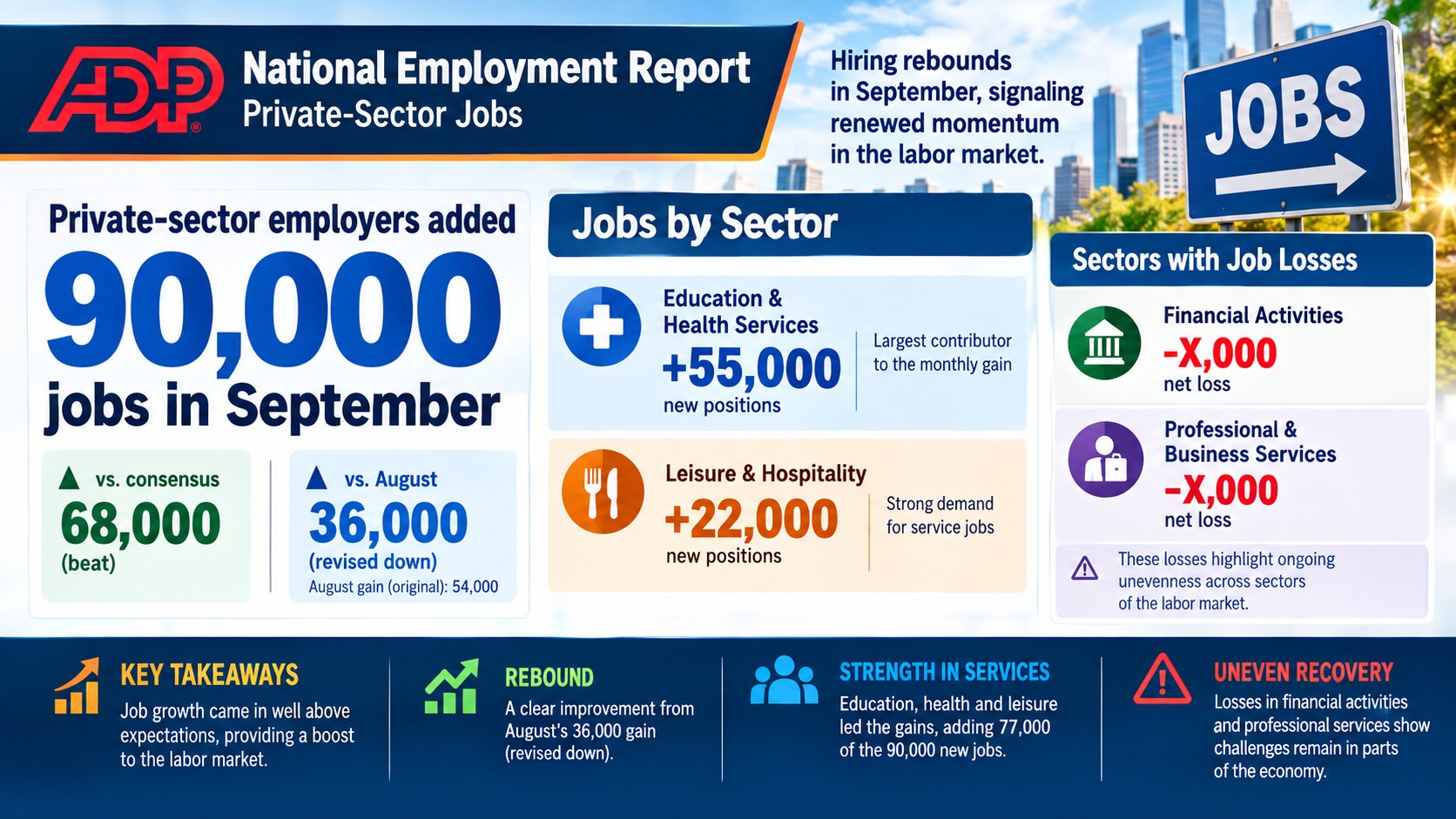
The ADP National Employment Report showed private-sector employment increased by 90,000 jobs in September. The figure surpassed economists’ expectations of roughly 68,000 and marked a clear acceleration from the downwardly revised 36,000 jobs added in August. Hiring strengthened for the first time since May, according to the payroll processor’s data derived from anonymized records covering more than 26 million U.S. private-sector workers.
Education and health services contributed the largest share of the gains with 55,000 positions, followed by leisure and hospitality at 22,000. Goods-producing industries added 31,000 jobs overall, including increases of 17,000 in manufacturing and 15,000 in construction. By contrast, financial activities lost 16,000 jobs and professional and business services declined by 11,000. Medium-sized firms accounted for a substantial portion of the net increase, while both smaller and larger establishments also recorded positive contributions.
Base pay for private-sector workers rose 3.2% year-over-year and gross pay increased 4.7%. Job-changers continued to see a larger wage premium than workers who remained with their employers. ADP Chief Economist Nela Richardson described the report as strong, noting that job creation rebounded after a three-month slowdown while pay growth remained solid. The data provide an early read on labor-market conditions ahead of the official Labor Department employment report scheduled for release on Friday.
A firmer private hiring print alongside the cooler-than-expected PCE inflation data released the same morning creates a nuanced backdrop for Federal Reserve policy. Stronger labor demand can help sustain consumer spending and economic growth, yet it also carries the risk of keeping wage pressures elevated at a time when the central bank is still working to return inflation sustainably to its 2% target. Markets will weigh the ADP results carefully against the softer price data when assessing the likelihood of additional rate increases later this year.
Sector-level detail revealed a concentration of gains in education, health care, and hospitality, while white-collar and financial services categories continued to show softness. This pattern is consistent with broader trends observed in recent months in which service-sector resilience has offset weakness in more interest-rate-sensitive areas. Construction and manufacturing contributions offered a modest positive signal for goods-producing employment after several periods of more muted activity.
Investors and policymakers will look to Friday’s nonfarm payrolls report for confirmation of the rebound suggested by the ADP figures. Consensus expectations heading into the official release had centered on a more moderate increase, so a stronger government print could reinforce the message of labor-market resilience. Conversely, a softer official number would raise questions about the durability of the September improvement captured in the private-sector data. Either outcome is likely to influence near-term pricing of Federal Reserve policy and equity market sentiment into the final quarter of the year.