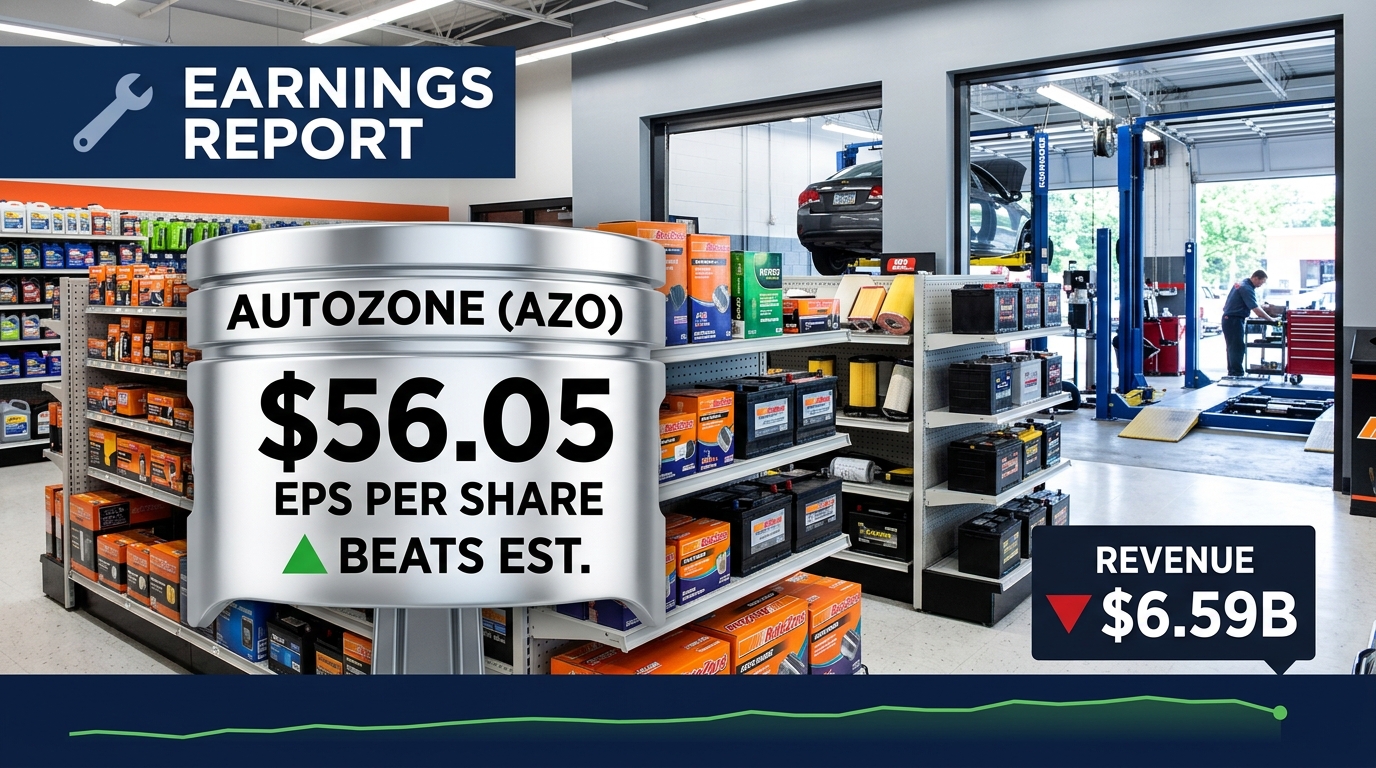
AutoZone delivered a decisive earnings beat for its fiscal fourth quarter of 2026, reporting net income of $931.6 million, or $56.05 per diluted share, comfortably ahead of the $54.14 consensus estimate compiled by analysts. The result caps a fiscal year in which the Memphis-based auto parts retailer leaned on disciplined cost management and a favorable tax and margin mix to offset softer top-line growth.
Revenue for the quarter came in at $6.59 billion, up 5.6% from the prior-year period but short of the roughly $6.69 billion Wall Street had penciled in. Same-store sales increased 2.7% for the quarter, a figure management pointed to as evidence that underlying demand for auto parts remains resilient even as the broader retail environment stays choppy.
A significant driver behind the earnings beat was a one-time boost from tariff refunds, which management said added roughly 145 basis points to gross margin, alongside a non-cash LIFO benefit. Analysts noted that while the headline EPS number looked strong, a portion of the outperformance reflected these non-recurring items rather than a pure operational improvement, tempering some of the enthusiasm around the print.
AutoZone's commercial business, which serves professional mechanics and repair shops rather than do-it-yourself customers, continued to outperform the retail side of the business. Domestic commercial sales rose 8.6% during the quarter, and CEO Phil Daniele said the company expects that trend to strengthen further as it heads into fiscal 2027.
"We expect sales to accelerate in each of our three markets — the United States, Mexico and Brazil — as we move into the new fiscal year," Daniele told analysts on the earnings call, citing improving sales trends late in the quarter as evidence the business has turned a corner after a sluggish start to the period.
For the full fiscal year, AutoZone reported net income of $2.57 billion, or $152.55 per share, on revenue of $20.34 billion. While full-year earnings beat consensus expectations, annual revenue fell short of Street forecasts, extending a pattern seen throughout the year of the company delivering strong profitability even as sales growth lagged behind.
The company also continued its aggressive capital return program, repurchasing $697.5 million of its own stock during the fourth quarter alone. AutoZone has long prioritized buybacks as a primary use of excess cash flow, a strategy that has helped support per-share earnings growth even in periods of more modest revenue expansion.
Despite the earnings beat, AutoZone shares have struggled in 2026, down roughly 17% since the start of the year and off about 32% over the trailing twelve months, significantly underperforming broader equity benchmarks over the same stretch. The stock's weakness reflects investor concerns about decelerating same-store sales growth, tariff-related cost pressures, and a broader pullback in consumer discretionary spending tied to elevated interest rates.
Investors will now look to the company's fiscal 2027 guidance and early-quarter commentary for signs of whether the promised sales acceleration materializes, particularly given AutoZone's exposure to an aging U.S. vehicle fleet that has historically supported demand for replacement parts regardless of the broader economic cycle. The stock's reaction in the sessions following the report will offer an early read on whether Wall Street views the tariff-refund-driven beat as durable or as a one-time accounting tailwind.