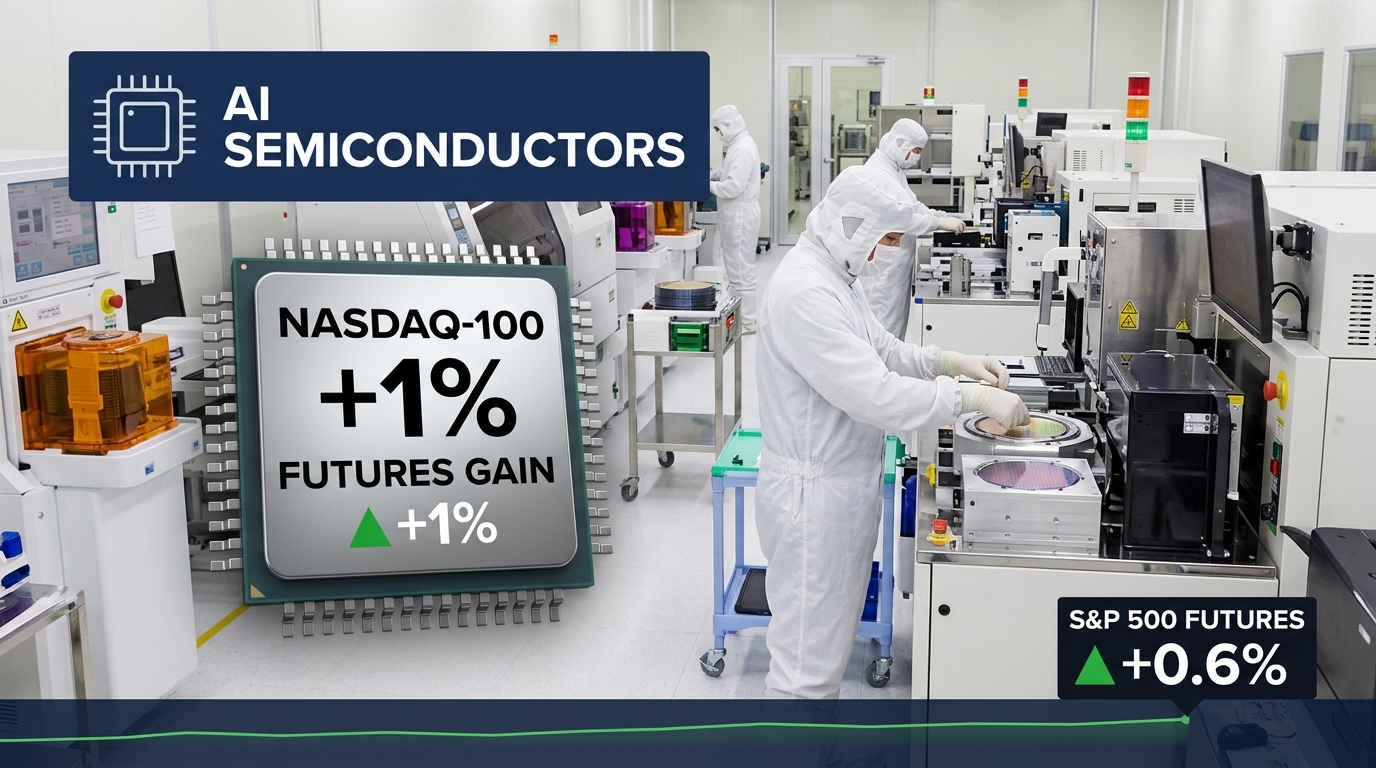
Nasdaq-100 futures climbed as much as 1% Monday, with semiconductor and AI infrastructure stocks leading the advance as investors positioned for a busy week that includes the anticipated Trump-Xi summit and a fresh wave of data on AI-related capital spending.
The chip sector's strength came alongside a broader risk-on tone across equity markets, with S&P 500 futures up 0.6% and Dow futures gaining roughly 450 points, according to CNBC and Bloomberg data. Falling oil prices and easing Treasury yields provided an additional tailwind, reducing some of the macro pressure that has weighed on high-multiple growth stocks in recent weeks.
Adding to the sector's momentum, research firm TrendForce said in a note that it expects Taiwan Semiconductor Manufacturing Company's CoWoS-L advanced packaging technology to remain the mainstream standard for AI accelerator chips through 2028, even as rivals introduce competing approaches. The firm specifically flagged Intel's EMIB-T packaging technology as an emerging alternative, though it does not expect EMIB-T to displace CoWoS-L's dominant market position over the medium term.
Nvidia and AMD are currently the largest users of TSMC's CoWoS-L technology for their flagship AI training and inference chips, according to TrendForce. The research firm also noted that major hyperscale cloud providers — including Meta, Amazon Web Services, and Microsoft — are increasingly adopting CoWoS-L packaging for their custom AI silicon programs, broadening demand for the technology beyond the traditional GPU makers.
The packaging bottleneck has been one of the defining supply chain stories of the AI buildout over the past two years, with TSMC repeatedly expanding CoWoS capacity to keep pace with orders from Nvidia and other customers. Advanced packaging techniques like CoWoS-L allow chipmakers to combine multiple compute dies and high-bandwidth memory stacks into a single package, a process that has become essential for building the large, power-efficient AI accelerators that hyperscalers require for training frontier models.
Intel's push into competing packaging approaches — including its EMIB-T technology and the newly reported Micro LED collaboration with Taiwan's AUO Optronics — reflects the company's broader strategy of positioning its foundry business as a viable alternative to TSMC for AI-era chip manufacturing. While TrendForce's outlook suggests TSMC will maintain its lead through the end of the decade, any signs of share gains for Intel's packaging technology would likely be closely watched by investors given the stakes involved in the AI infrastructure buildout.
Monday's rally in chip stocks also comes as investors look ahead to the Trump-Xi summit scheduled for September 24, where technology export policy and Taiwan-related tensions are expected to be discussed. Any signal of reduced trade friction between the U.S. and China could further support sentiment toward semiconductor stocks, which have been sensitive to export control policy throughout the year given the sector's reliance on both Chinese demand and Taiwanese manufacturing capacity.
Options market activity suggested elevated interest in semiconductor names heading into the summit, with traders positioning for potential volatility depending on the tone of the talks. For now, the combination of falling oil prices, easing yields, and steady AI infrastructure demand has been enough to keep chip stocks among the market's best-performing groups to start the week.