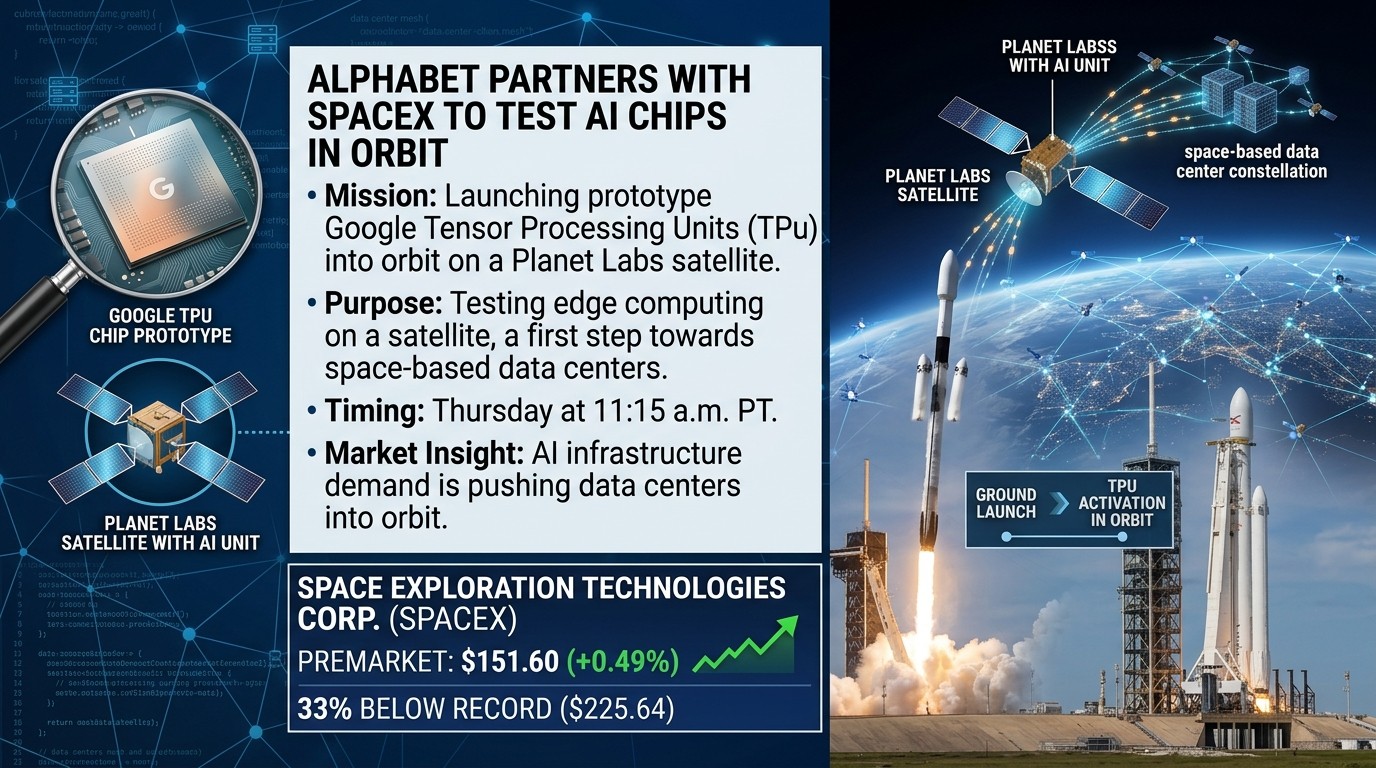
Alphabet (GOOG) plans to launch its homegrown artificial intelligence chips into orbit on Thursday aboard a SpaceX Falcon 9 rocket, a step toward making data centers in space a practical reality. The launch is scheduled for 11:15 a.m. PT from Vandenberg Space Force Base in Santa Barbara County, California, as part of the uncrewed Transporter-18 mission.
The mission will carry satellites from Planet Labs (PL), including a solar-powered prototype that hosts Google's tensor processing units, or TPUs. The payload is an early test of whether advanced AI processors can operate in orbit, where solar power is abundant and the land and permitting constraints of terrestrial facilities disappear.
SpaceX (SPCX) has promoted supercomputers in space as the next frontier in AI infrastructure, touting what it describes as infinite real estate in orbit as a way to escape the backlash against data centers on the ground. Shares of the Elon Musk-led aerospace and AI company rose 0.49% to $151.60 in premarket trading ahead of the launch.
The stock debuted at $135 per share on June 12 and climbed to a record $225.64 on June 16, meaning it still trades about 33% below its peak but roughly 12% above its debut price. Investors will watch whether a successful launch revives enthusiasm for space-based computing or whether elevated Treasury yields, which weigh on high-valuation growth shares, keep a lid on the stock.
The experiment arrives as AI infrastructure spending is generating enormous earnings elsewhere in the supply chain. A leading memory chipmaker reported record fiscal fourth-quarter revenue of $54.23 billion after the close on Wednesday and guided far above consensus, underlining that demand for AI hardware remains intense. Asian chip stocks rallied sharply overnight, with Japan's Nikkei 225 gaining roughly 3%.
Public attitudes are also shaping the debate over AI expansion. A Quinnipiac University poll cited by Bloomberg found that 91% of Americans say it is important for the U.S. to establish guardrails for AI systems, and 81% said safety should come before the pursuit of innovation. Concerns about data center impacts on local communities are one reason companies are exploring alternative locations for computing capacity.
From a trading perspective, the launch is a sentiment catalyst more than a near-term earnings driver. Revenue from orbital computing remains speculative, and any technical failure or delay could hit the shares of the companies involved. Investors seeking exposure to the AI theme may prefer to focus on established earnings growth while treating space-based computing as a long-dated option. Watch the 11:15 a.m. PT launch window and the reaction in all three tickers afterwards.