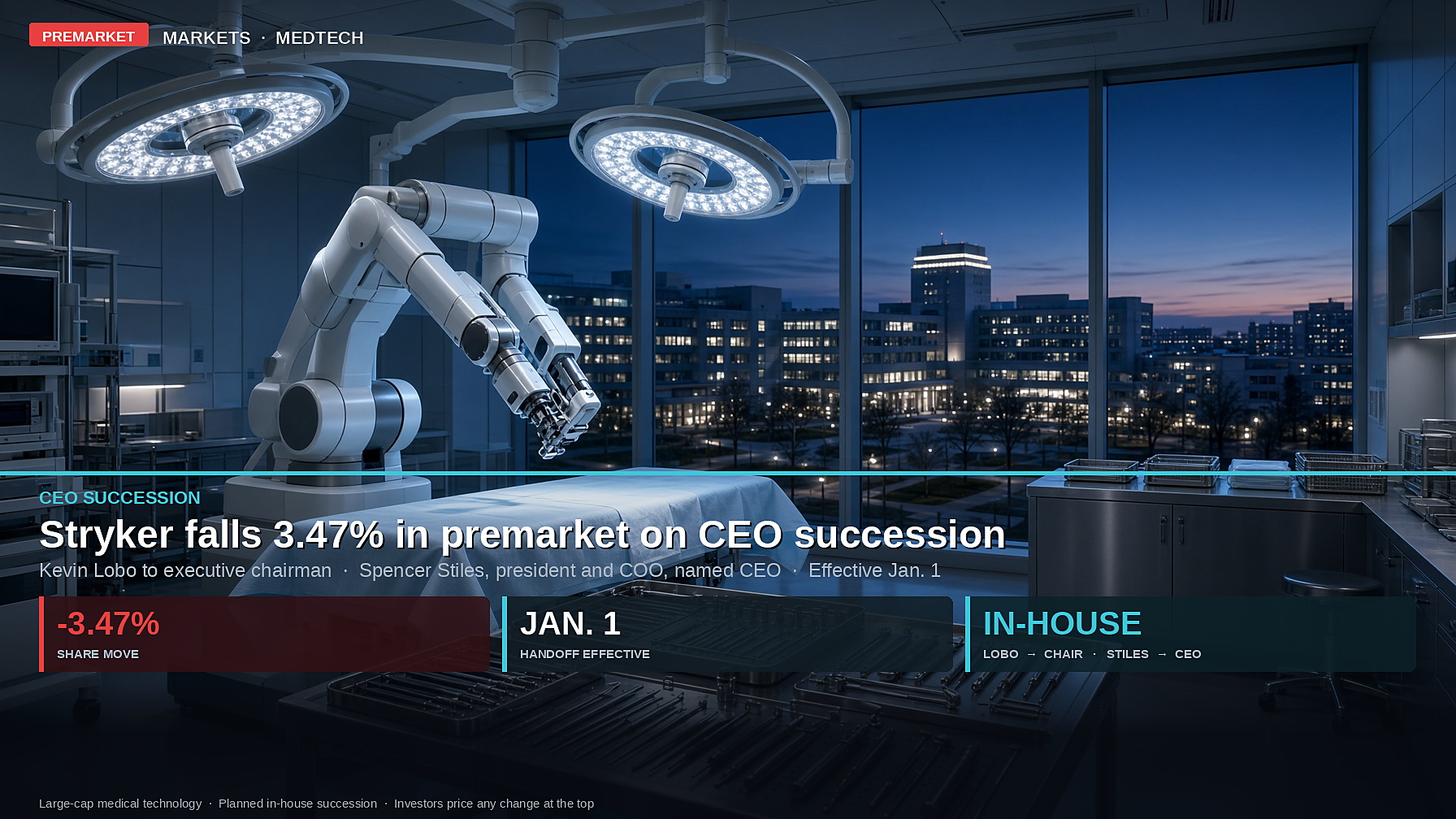
Stryker shares fell 3.47% in premarket trading on Tuesday after the medical technology company announced a formal CEO succession plan. Kevin Lobo will transition to executive chairman of the board, while current President and Chief Operating Officer Spencer Stiles will become chief executive officer. Both changes take effect on January 1.
The announcement sets a clear timeline for the leadership handoff roughly three months from now. Naming the sitting president and COO as successor signals continuity of strategy, and moving the outgoing CEO into an executive chairman role keeps his experience close during the transition.
Even orderly successions can trigger selling. Investors often react to uncertainty about whether a new CEO will maintain the pace of growth, capital allocation, and acquisitions that defined the prior tenure, and a premarket pullback of a few percentage points reflects that caution rather than a repricing of the business.
The decline was one of several notable stock-specific moves in premarket trading. Another healthcare name surged more than 20% on a buyout report, illustrating the stock-specific volatility in the sector, while an electronic trading marketplace fell 4.59% amid multidecade-high Treasury yields and profit-taking.
The broader market backdrop is constructive. The Nasdaq closed at a record on Monday, futures were higher Tuesday, and oil prices were falling after the G7 agreed to release 100 million barrels of reserves. Capital.com analysts noted that earnings growth estimates for the upcoming season have been revised up to nearly 30%, though the strength is concentrated in AI names rather than defensive sectors such as healthcare.
Succession announcements are rarely the last word. Management commentary at upcoming earnings, any changes to the executive team under the new CEO, and forward guidance will determine whether the dip reflects a lasting concern or a short-term reaction. Investors will likely look for assurances that the strategy, product pipeline, and acquisition approach remain intact.
For portfolio managers, the question is whether the pullback creates an entry in a quality healthcare name or signals more downside. Medical technology stocks are sensitive to interest rates because their valuations depend on long-duration earnings. With the 10-year Treasury yield above 5.3%, a multidecade high, the sector faces valuation pressure independent of any leadership change.
Technical levels and volume at the open will help clarify the picture. A drop that stabilizes on declining volume suggests sellers are exhausted, while a break lower on heavy volume can signal further repricing. Because the leadership change is scheduled and not abrupt, the event is unlikely to alter near-term fundamentals, which may favor patient buyers over aggressive sellers.