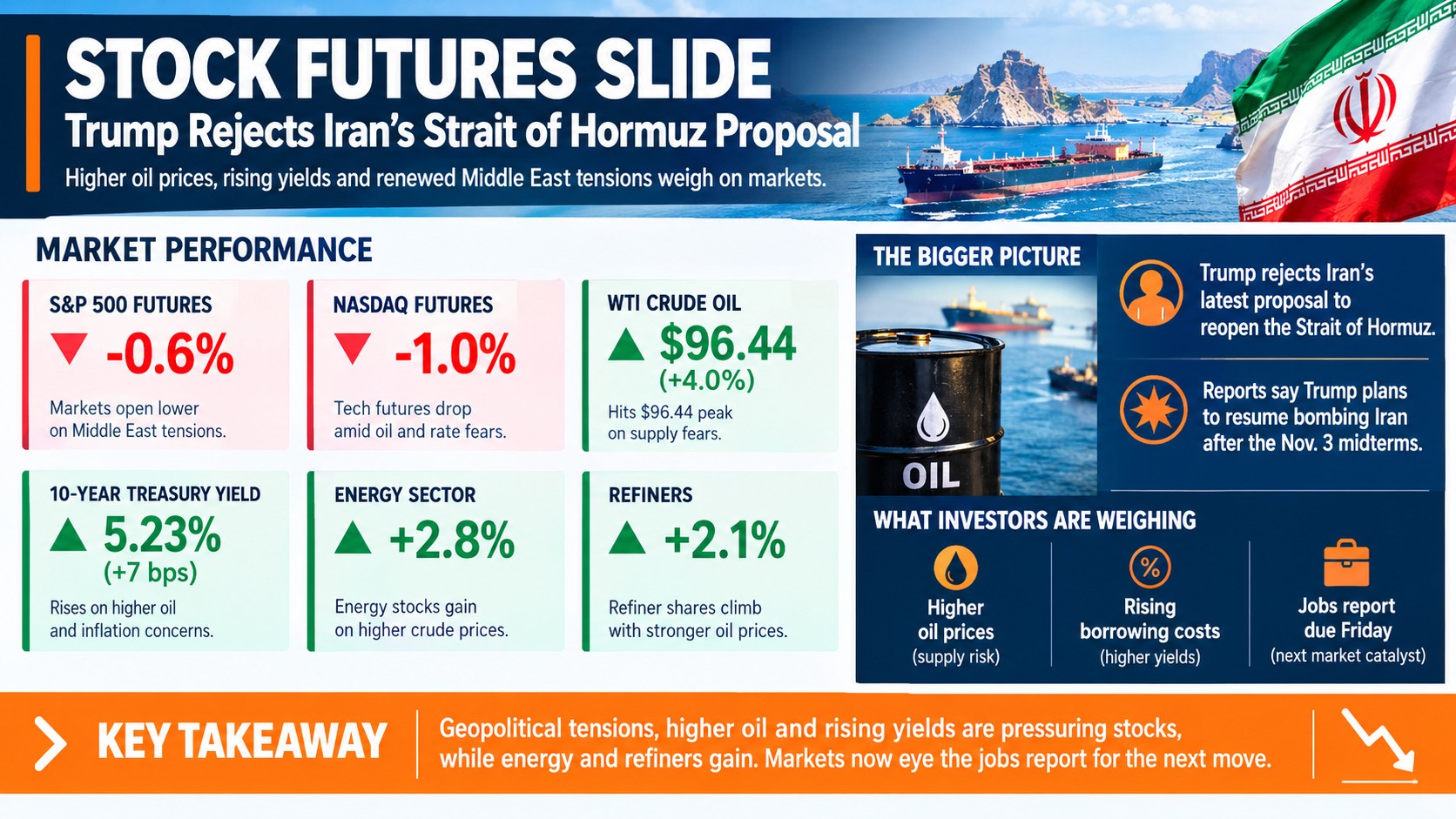
U.S. stock futures fell on Monday, September 28, 2026, after President Donald Trump rejected Iran's latest proposal to reopen the Strait of Hormuz, reviving fears of prolonged supply disruption in the world's most important oil chokepoint. S&P 500 futures were down about 0.6% near 7,761, Nasdaq futures dropped roughly 1% to around 30,573, and Dow futures slipped 0.48% to about 51,911. The pullback erased part of Friday's rally, when the S&P 500 gained 0.51% to 7,743.31 and the Dow rose 0.93% to 51,828.62 on hopes of a phased U.S.-Iran deal.
Crude oil was the main transmission channel. West Texas Intermediate futures jumped more than 4%, touching a session peak of $96.44 a barrel, while Brent traded around $108 after a gain of more than $4. Reports said Trump told advisers he plans to restart bombing Iran after the midterm elections on November 3, and Iran's foreign minister said Tehran is prepared to resume war while leaving the door open to diplomacy. Energy producers and refiners advanced in early trading, while technology and semiconductor shares led declines.
Bonds sold off in tandem. The benchmark 10-year Treasury yield rose about 7 basis points to roughly 5.23%, extending a bond-market rout that has become a defining feature of September, and the rate-sensitive two-year yield climbed to about 4.9%. Higher yields raise discount rates on long-duration growth stocks and push mortgage rates, already above 7%, further from affordability. Gold fell about $132 to near $4,189 an ounce as the dollar and yields bounced, while the euro slipped to 1.137 and the yen weakened to around 157 per dollar. The combination of a stronger dollar, higher oil and higher yields tightens financial conditions at a time when investors were hoping for relief.
Overseas markets were mixed. Japan's Nikkei fell 485 points to 65,877, Hong Kong's Hang Seng gained 132 points to 24,642, Germany's DAX was little changed at 25,405 and the FTSE 100 rose 27 points to 10,722. China separately said it will cut tariffs on a range of U.S. agricultural goods but excluded soybeans, which remain subject to an additional 10% tariff, and reported that August industrial profit growth slowed to 4.2%, the weakest pace of the year.
The data calendar is dense. The Dallas Fed manufacturing survey is due at 10:30 a.m. Eastern time Monday, JOLTS job openings and the S&P/Case-Shiller home price index arrive Tuesday, final second-quarter GDP and core PCE inflation land Wednesday, and the September jobs report follows Friday. Chipmakers and electronics suppliers are also scheduled to report Wednesday, giving investors a read on AI hardware demand at a moment when yields are pressuring valuations.
For portfolio positioning, the setup favors caution on rate-sensitive and high-multiple technology exposure, while energy and defense-related names benefit from the geopolitical premium. A durable move lower in oil would likely require a credible diplomatic breakthrough, which the administration's stance makes unlikely before the midterms. Investors should watch whether the 10-year yield holds above 5.2%, whether Brent sustains levels above $100, and whether futures can reclaim key resistance near 7,800 on the S&P 500. Absent a catalyst, rallies are more likely to be sold than bought.
Volatility is likely to remain elevated. With the jobs report at week's end and inflation data midweek, positioning should account for two-way risk: an oil-driven inflation scare on one side and a diplomatic surprise that could rapidly unwind the energy premium on the other. Position sizes and stop levels matter more than conviction in this tape.